Agentic AI SEO.
Wrappers are dead. In 2026, SEO is no longer about “prompts.” It's about autonomous agents that think, research, and execute like a 10-year SEO veteran.
The engineering behind autonomous SEO.
Every number below maps to a real line of production code.
The OpenAI responses.create() protocol.
Harbor is built on the OpenAI Responses API with strict JSON Schema mode — enabling autonomous multi-step reasoning with typed outputs.
Strict JSON Schema Output
Every agent response uses json_schema format with strict: true for guaranteed parseable output.
Multi-Step Tool Invocation
Agents call sitemap parsers, web scrapers, and extraction tools in a single uninterrupted logic chain. Each tool result feeds the next decision.
Iterative Reasoning Cycles
The agent doesn't write until it understands — iteratively scraping competitors, analyzing your sitemap, and validating facts against live data.
Resilient Batch Processing
Uses Promise.allSettled() for parallel URL processing — failed URLs don't crash the entire batch.
The agent doesn't just generate. It researches.
Objective Decomposition
The Harbor Agent receives a business objective and decomposes it into sub-tasks: sitemap index analysis, AI-powered sitemap selection (filtering out /de/, /fr/, /es/ variants), and semantic gap identification across your existing content.
Uses domain-scoped queries to fetch all previous titles from the same hostname, ensuring zero cannibalization.
Autonomous Tool Selection
The agent autonomously chains 9+ tools: scrape_url for standard pages, scrape_with_brightdata for Cloudflare-protected sites, parse_sitemap_chunk for large sitemaps (500 URLs/batch), and web_search for real-time competitor discovery.
Tool selection is non-deterministic - the agent reasons about which tool to use based on URL patterns and previous failures.
The Responses API Loop
Using OpenAI's responses.create() API with JSON Schema mode, the agent enters an iterative reasoning cycle. It validates facts against scraped content, checks internal link relevance against your sitemap, and refines tone BEFORE generating content.
Each loop iteration can invoke multiple tools, process results, and decide whether to continue or output final content.
Authority-First Deployment
The final output includes strategically mapped internal links (based on semantic graph analysis), custom Nano Banana visuals generated from article context, and citations verified against live web sources.
Internal links are selected from your actual sitemap URLs, scored by relevance, and inserted at semantically appropriate positions.
9+ tools the agent chooses from.
Unlike static AI wrappers, Harbor agents autonomously select and chain these tools based on real-time conditions.
Fetch web content as markdown with automatic Cloudflare bypass fallback
Force enterprise proxy for heavily protected sites
Parallel extraction of 5+ URLs simultaneously
Extract all URLs from sitemap indexes recursively
Analyze sitemap structure before full extraction
Batch 500 URLs from large sitemaps efficiently
AI-selected sitemap extraction (300 URLs per sitemap)
Auto-discover sitemap via robots.txt and common paths
Real-time search integration for competitor discovery
Static vs. agentic SEO.
The move from 1st-generation AI wrappers to 2nd-generation autonomous ecosystems.
The wrapper era.
- ✕ Linear prompting (text in → text out)
- ✕ Zero context of existing sitemap
- ✕ Hallucinated facts / no real-time search
- ✕ Manual internal linking required
Autonomous reasoning.
- ✓ Recursive tool-use reasoning loop
- ✓ Deep knowledge-graph site awareness
- ✓ Real-time verified factual citations
- ✓ Autonomous schema & internal architecture
4-layer anti-repetition architecture.
Unlike 1st-gen AI wrappers that blindly generate content, Harbor enforces explicit deduplication at every stage.
Domain-Level Title Deduplication
Before generating any keyword, Harbor queries all previously generated titles from your domain. The AI receives an explicit list of existing titles with instructions to avoid semantic overlap.
getAllPreviousSiteSeekerTitles({ sitemapUrl })Status-Filtered Collision Detection
Only completed, non-generating records are included in deduplication. In-progress articles won't block new topics, but finished content creates a permanent exclusion zone.
status === 'completed' && siteSeeker.keywords4-Level Anti-Duplication Rules
AI receives explicit instructions: (1) No identical titles, (2) No similar titles with different wording, (3) No same specific topic with different framing, (4) Focus on new angles and adjacent topics.
previousTitlesSection in systemPromptSemantic Distinctness Enforcement
For pillar generation, the AI must create 15 distinct subniches with zero semantic overlap. Each pillar must be completely different - no two pillars can cover similar ground.
NEVER repeat topics or create pillars that are semantically similarEach module is a fully autonomous agent.
Specialized capabilities — composable into a single end-to-end pipeline.

Sitemap Intelligence
Autonomous extraction of sitemap data with AI-powered selection. Filters out foreign language variants, prioritizes money pages, and builds a complete topical map.

Semantic Link Architect
Agent-negotiated internal links based on your actual sitemap URLs. Each link is scored for relevance and placed at semantically appropriate positions.
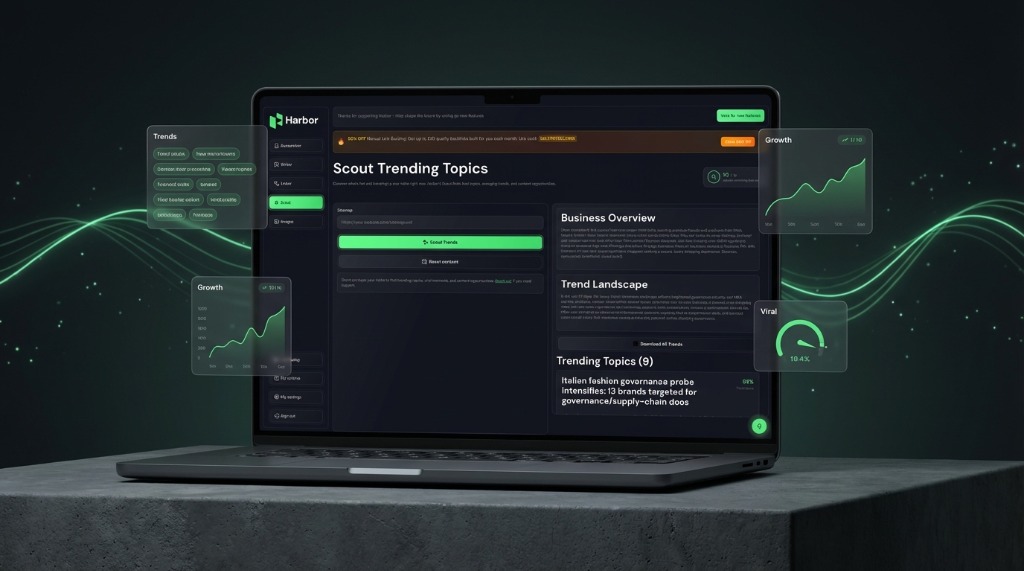
Scout Trend-Agent
Real-time trend discovery with built-in deduplication. Tracks previously suggested keywords to ensure fresh, non-overlapping opportunities.
The 8-minute reasoning cycle.
Other tools boast 10-second generation. Harbor intentionally takes 8 minutes — because the agent needs time to scrape 50 pages, analyze your sitemap, and verify every internal link.
Own the agentic SERP.
Legacy SEO is dying. Deploy the Harbor autonomous suite today.