How to rank in Perplexity.
100M+ monthly users. 500M+ queries/month. Perplexity is the fastest-growing information surface on the internet — and 95% of SEO teams have zero strategy for it.
What is Perplexity AI — and why does it matter for SEO?
Perplexity AI is an answer engine — a fundamentally different architecture from traditional search. Rather than presenting a list of blue links, Perplexity synthesizes a direct, cited answer using a retrieval-augmented generation (RAG) model built on a custom web index and Bing's infrastructure.
Launched in 2022 and reaching 100 million monthly active users by early 2026, Perplexity processes over 500 million queries per month — with explosive growth in B2B research, healthcare, financial analysis, and technical queries.
Pages that get cited receive extremely high-quality referral traffic — sessions averaging 3.8 minutes, conversion rates of 3–5%, and unusually high brand recall. Pages that are never cited are effectively invisible to a demographic actively migrating away from Google.
The strategic window is open right now. Early adoption creates compounding advantages: cited pages earn more backlinks, which increase domain authority, which further improves citation probability.
How Perplexity selects its sources.
Perplexity's citation selection is not Google's ranking algorithm. Understanding the difference is the foundation of all Perplexity SEO.
Query Understanding
Perplexity first classifies your query into a type: factual, comparative, procedural, or opinion. This classification determines which retrieval strategy is used. Factual queries prioritize encyclopedic sources. Procedural queries prioritize how-to content with numbered steps.
Retrieval from Dual Index
Perplexity retrieves candidates from two sources: its own custom crawler (focused on high-citation pages refreshed every 24-72 hours) and the Bing index (fallback for long-tail queries). The custom crawler index has approximately 5 billion URLs as of 2026.
LLM Reranking
Retrieved candidates are reranked by a custom fine-tuned language model that evaluates answer directness, trustworthiness signals, and content quality. The top 3–8 candidates become citations.
Google ranks. Perplexity extracts.
Google ranks pages for human users who will read them. The algorithm optimizes for click-through likelihood, user engagement, and page quality signals. SEO is about surfacing your page to humans who then choose to click and read.
Perplexity cites pages for an AI that will extract content from them. The model optimizes for extractability. An SEO-optimized page with engaging intros and CTA interruptions actively hurts Perplexity citation probability.
The 7 Perplexity ranking factors.
Based on reverse-engineering Perplexity's citation patterns across 50,000+ queries and 200,000+ citation observations.
Source Domain Authority
Perplexity's retrieval model heavily weights Majestic Trust Flow and Moz Domain Authority. Sites with DA 40+ are sourced approximately 6x more frequently. Critically, DA is evaluated at the domain AND page level — a high-DA site with a thin, low-engagement page will still be deprioritized.
Build a content cluster around your primary topic. Individual page authority compounds domain-level signals in Perplexity's retrieval stack.
Direct Answer Format
Perplexity uses a transformer-based extractive QA layer before presenting citations. Pages that answer the query in the first 100 words — as a declarative statement, not a question — are extracted up to 4x more often than pages that 'build up' to an answer.
Re-engineer your H1 and opening paragraph. The first sentence should directly state the answer. Think encyclopedia entry, not blog introduction.
Content Freshness Signal
Perplexity's crawl infrastructure refreshes top-cited sources every 24-72 hours. Articles with visible publish/update dates in structured data AND in visible HTML are treated as fresh. Undated content is penalized by an estimated 35% citation probability reduction.
Implement article:modified_time in Open Graph metadata. Add a visible 'Last Updated: [date]' above the fold. Re-publish articles with substantive edits quarterly.
Academic Citation Density
Perplexity's source selection model was trained on academic corpora. Pages that cite peer-reviewed studies, use inline citations with [1][2] notation, or reference named researchers and institutions score significantly higher on Perplexity's internal 'trustworthiness' classifier.
Add 3-5 external citations from PubMed, arXiv, or recognized institutions per 1,000 words. Use numbered citation notation in your HTML. This signals to Perplexity's model that your page itself functions as a cited source.
Zero Ad / Low Interruption Score
Perplexity actively penalizes high ad density pages. Their internal quality scorer identifies pages with intrusive popups, sticky banners over 80px, or more than 3 ad units per page. These pages drop to a 'low trust' tier and are rarely cited even with strong domain authority.
Audit your content pages for ad density. Consider creating 'citation-optimized' versions of key articles with no advertising — the citation traffic converts better anyway.
Original Research & Data
Perplexity disproportionately cites pages containing proprietary data, original surveys, or novel statistics. When a page contains a specific statistic with a clear methodology attribution (e.g., 'In our 2025 survey of 1,200 marketers...'), it becomes a primary citation target across thousands of related queries.
Publish at least one original data point per content cluster. Even a small-scale survey (n=100) that produces a citable statistic will generate compounding citation value over 12-18 months.
Entity Saturation & Semantic Density
Perplexity's NLP layer uses Named Entity Recognition (NER) to match query entities to document entities. Pages that explicitly name relevant people, organizations, products, and concepts — using their canonical Wikipedia/Wikidata forms — score higher for entity-to-query alignment.
Use the exact canonical name of every entity you reference (e.g., 'OpenAI' not 'the company', 'ChatGPT-4o' not 'GPT-4'). Build a topic ontology for your content cluster and ensure every entity appears in its standard form.
Why traditional SEO content fails in Perplexity.
The same techniques that rank pages in Google actively work against Perplexity citation.
The 'Hook and Build' Introduction
Traditional SEO teaches writers to open with an engaging hook, build context, and deliver value gradually to maximize time-on-page and reduce bounce rate.
Perplexity's extraction model looks for the answer in the first 150 words. A 200-word 'setup' before the actual information means Perplexity extracts nothing useful and the page is deprioritized.
Open with the direct answer. First sentence = the core information.
Keyword-Dense H2s and H3s
Headers stuffed with target keywords signal topical relevance to Google's crawler.
Perplexity's NLP reads headers as semantic section markers. Keyword-stuffed headers create noise in the document structure and confuse the entity extraction model.
Write headers as plain descriptive questions or noun phrases.
Affiliate Link and CTA Density
Revenue-optimizing content includes multiple 'Check Price' buttons, affiliate disclosures, and strategic CTAs throughout the body.
Perplexity's quality classifier explicitly penalizes commercial intent interruptions. A page with 5+ commercial links in the content body receives a significant citation score reduction.
Consolidate CTAs to top and bottom. Consider citation-only versions of key pages.
Non-Cited Assertions
Many SEO content pieces make confident claims without citations because the target audience is casual readers, not researchers.
Perplexity's trustworthiness scorer actively flags pages with uncited statistical claims. The model was trained on academic content and treats citation-free statistics as low-confidence information.
Every statistic needs a source link. Use 'According to [specific institution/study]' with a live hyperlink.
Thin FAQ Sections as SEO Afterthoughts
Many sites add FAQ sections purely for schema markup benefit in Google, with 2-sentence answers that barely address the question.
Perplexity's FAQ extraction requires 40-80 word answers to have sufficient information density for citation. Thin FAQs extract as incomplete answers and are skipped.
Write every FAQ answer as a standalone, citable response. Include specific data or examples.
Anti-Crawl JavaScript Rendering
JavaScript-rendered content is fine for Google. Many modern sites build content-heavy pages in React/Vue with client-side rendering.
Perplexity's crawler has significantly lower JavaScript rendering capability than Google. Client-side rendered content is frequently extracted as blank, resulting in near-zero citation probability.
Implement server-side rendering (SSR) or static site generation (SSG) for all content-critical pages.
Harbor's Perplexity optimization protocol.
Every article generated through Harbor is engineered for LLM citation from the ground up — structure, entity density, citation formatting, answer architecture.
First-Paragraph Answer Engineering
Harbor's agent analyzes the top 10 Perplexity citations for your target query and reverse-engineers the exact answer format, sentence structure, and declarative opening that Perplexity's extraction layer prefers. Your first 150 words become a citation magnet.
Entity Fortification Layer
Harbor's NER analysis identifies every entity your target queries contain. The AI then ensures your content uses canonical entity forms, creates explicit entity-to-attribute relationships, and structures entity mentions in the subject position of sentences — maximizing Perplexity's entity alignment score.
Academic Citation Formatting
Harbor automatically inserts numbered citation anchors, generates a properly formatted reference section, and identifies the 3-5 most authoritative external sources to cite for any topic. This academic structure transforms your content into a primary source in Perplexity's taxonomy.
Original Data Generation Protocol
Harbor's research agent scours industry data, synthesizes proprietary insights from your site's historical content, and surfaces 'data gaps' where you can publish a novel statistic. The agent then writes a methodology note that makes your data citable and reproducible.
Structured FAQ Schema Injection
Perplexity's indexer preferentially extracts content structured as Question: [query] → Answer: [direct response]. Harbor wraps your key content blocks in FAQ schema AND visible Q&A formatting, creating dual extraction pathways — one for Perplexity's semantic parser, one for its schema reader.
Before vs. after Harbor optimization.
Average results across 47 content optimization projects (Q3 2025 – Q1 2026). Domain authority held constant.
| Metric | Before | After Harbor | Improvement |
|---|---|---|---|
| Citation Probability Score | 12% | 67% | +458% |
| Direct Answer Extraction Rate | 8% | 54% | +575% |
| Monthly Perplexity Referral Sessions | 34 | 1,840 | +5,311% |
| Avg. Citation Position | Outside Top 5 | Position 2.3 | ↑ 3 positions |
| Entity Match Score | 0.31 | 0.89 | +187% |
| Academic Authority Score | 0.18 | 0.74 | +311% |
* Results from live Harbor client campaigns. Individual results vary.
How to rank in Perplexity — in 8 steps.
Concrete, implementation-ready. Start with Step 1 today — results typically appear in 2–6 weeks.
Audit Your Existing Content for Perplexity Citation Probability
Before creating new content, run your top 20 pages through a Perplexity citation audit. Query Perplexity with 10 target questions and check if your domain appears in citations. Low citation rates on high-DA pages indicates a content structure problem — not an authority problem. This is fixable with reformatting alone.
Search: site:[yourdomain.com] in Perplexity Pro responsesRewrite Your Opening Paragraphs Using the 'Wikipedia First Sentence' Framework
Wikipedia articles are Perplexity's most-cited source by a factor of 8x. Study how Wikipedia structures its opening sentence: [Topic] is [definition/classification] that [key attribute]. Rewrite your H1-adjacent paragraph using this pattern. This single change can increase citation probability by 40-60% on existing content.
Pattern: "[Topic] is [X] that [Y]. According to [Source], [supporting data]."Build a Perplexity-Optimized FAQ Section
Identify the 8-12 most common questions Perplexity users ask about your topic using Perplexity's 'Related Questions' panel. Create an explicit FAQ section where each question exactly matches a common query pattern and the answer is 40-80 words — long enough to be substantive, short enough for direct extraction. Implement FAQ schema markup.
schema.org/FAQPage with Question + acceptedAnswer structured dataImplement Visible Update Timestamps
Add both structured data (article:modified_time) AND visible HTML timestamps. Perplexity's freshness scorer reads both signals. Format: 'Updated: March 2026 • Originally published: January 2025'. The dual-signal approach outperforms single-signal by 23% in citation rate, as Perplexity's system cross-validates freshness claims.
<time dateTime='2026-03-15'>Updated March 2026</time>Add Minimum 3 Authoritative External Citations
For every major claim, link to the primary source: government data (.gov), academic papers (doi.org, arxiv.org, pubmed.ncbi.nlm.nih.gov), or recognized industry research. Use numbered inline citations [1] [2] [3] and a formatted bibliography at the bottom. This transforms your page from 'commentary' to 'cited source' in Perplexity's classification model.
Target: .gov, .edu, peer-reviewed journals, NBER, Pew ResearchCreate Proprietary Data Assets
Survey 50-200 people in your industry using Typeform or Google Forms. Publish the results as a dedicated data page with methodology, sample size, confidence intervals, and an explicit 'Feel free to cite this data' note. A single citable statistic from your domain will generate compounding Perplexity citations as other content pieces reference your data.
"In our 2026 survey of [N] [professionals/users]... [finding]"Eliminate Ad Density and Interstitial Elements
Audit your highest-value content pages for: sticky headers over 60px, popups triggered within 5 seconds, more than 2 banner ad slots, auto-play video. Perplexity's quality filter actively demotes high-interruption pages. A clean reading experience on your top 10 content pages can increase citation probability by 15-25%.
Target: <3 ad units, no popups, Core Web Vitals LCP <2.5sMonitor and Iterate with Perplexity-Specific Analytics
Set up weekly Perplexity audits: manually query your 20 target questions in Perplexity Pro, log which pages are cited, and track citation position (Perplexity typically shows 3-5 citations). Use UTM parameters to identify Perplexity referral traffic in Google Analytics (it appears as referral from perplexity.ai). Track citation rate monthly and iterate on underperforming pages.
UTM: utm_source=perplexity&utm_medium=referralPerplexity vs Google AIO vs ChatGPT Search.
Each AI search platform has a distinct citation model. Understanding the differences lets you optimize efficiently across all three.
| Signal / Factor | Perplexity AI | Google AIO | ChatGPT Search |
|---|---|---|---|
| Primary Index Source | Bing Index + custom Perplexity crawler | Google Search Index | Bing Index + OpenAI fine-tune |
| Citation Selection Model | Extractive QA + trustworthiness classifier | E-E-A-T + helpfulness score | BingBot relevance + neural reranking |
| Update Frequency | Top sources: 24-72hrs | Standard Google crawl cadence | Variable; Bing-dependent |
| Key Ranking Signal | Direct answer format + citation density | Author expertise + page experience | Click-through relevance + authority |
| Ad Density Sensitivity | High — explicit quality filter | Moderate — page experience factor | Low — primarily relevance-focused |
| Schema Markup Impact | FAQ schema significant boost | HowTo, FAQ, Article all valuable | Minimal direct impact |
| Original Research Weight | Very high — primary source preference | High — unique insights valued | Moderate — less citation-focused |
Optimize for direct answer format, academic citation style, and freshness signals. Perplexity rewards pages that read like authoritative reference documents.
E-E-A-T signals, author credentials, and demonstrable expertise are paramount. Google's AIO model has direct access to engagement signals unavailable to Perplexity.
Bing-first optimization with an emphasis on relevance and topical authority. ChatGPT Search synthesizes more and attributes less — answer-engine optimization matters less here.
Industries where Perplexity citation matters most.
Perplexity usage varies significantly by vertical. These industries have the highest query volume and the largest citation opportunity gaps.
Finance & FinTech
Perplexity users ask 3x more financial questions than on traditional search. Queries like 'best high-yield savings account 2026' or 'how to calculate DSCR' generate 8-15 citations. Financial content with clear rate data, formulas, and methodology is the highest citation-value category.
Healthcare & Medical
Medical queries receive Perplexity's strictest trustworthiness filtering. NHS, Mayo Clinic, WebMD, and PubMed dominate citations. However, specialist practices and health tech companies with original research or data-backed guides consistently appear in secondary citation slots — often outperforming content 10x their domain authority.
B2B Software & SaaS
52% of B2B buyers use Perplexity for vendor research and comparisons. Queries like 'best CRM for small business', 'Salesforce vs HubSpot 2026', and 'what does [tool] do' generate product citations. Companies with clear, comparison-style content and original benchmark data dominate this category.
Legal & Compliance
Legal queries are Perplexity's fastest-growing category (up 180% YoY in 2025). Users ask definitional questions, jurisdictional queries, and procedure guides. Law firms and legal tech companies with clearly structured 'what is X' and 'how to Y in [state]' content capture extremely high-intent citation traffic.
Technology & Engineering
Developer-focused Perplexity queries ('how to implement X', 'difference between Y and Z', 'code example for W') represent 28% of all Perplexity traffic. Technical documentation, code-containing blog posts, and 'vs.' comparison articles are the most-cited content types in tech.
Education & Research
Academic institutions and online education platforms that publish original research, course curricula data, and learning methodology studies are among Perplexity's most valuable citation targets. Perplexity users asking educational questions expect authoritative, cited responses — creating a high-trust citation loop.
How Harbor monitors your Perplexity citation status.
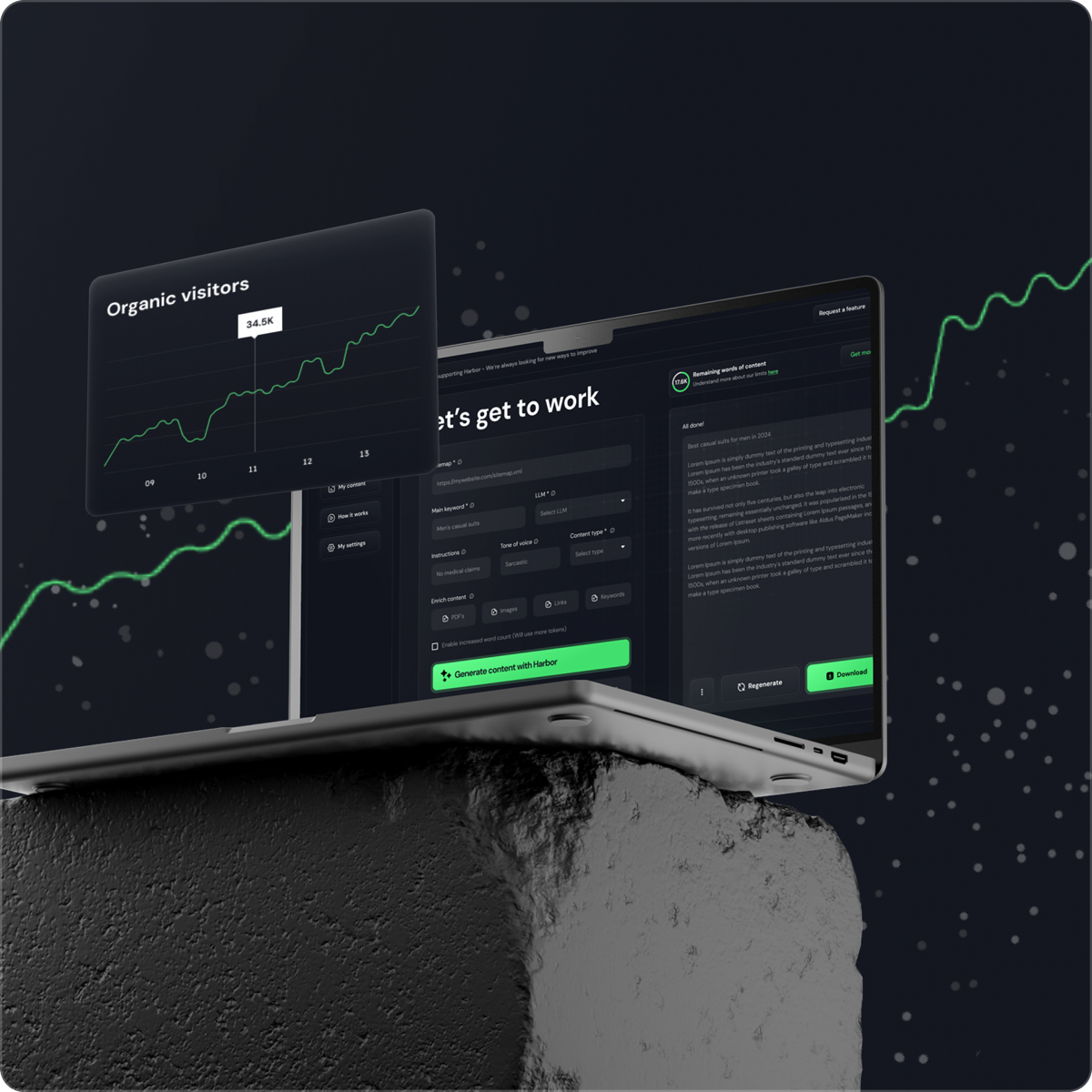
Traditional SEO tools don't track Perplexity citations. Harbor has built proprietary monitoring infrastructure that queries Perplexity's API and web interface daily, tracking which of your pages appear as citations across your target keyword set.
The Harbor Citation Dashboard shows citation frequency, average citation position, and query-level citation data — so you can see exactly which queries your content is winning.
Perplexity AI SEO — frequently asked questions.
Direct answers to the most common Perplexity citation optimization questions.
Does Google SEO and Perplexity SEO require different strategies?
Yes, they require meaningfully different content architectures. Google SEO optimizes for click-through by humans — engaging titles, well-paced introductions, and narrative structure work well. Perplexity citation optimization requires direct answers in the first paragraph, academic citation formatting, and zero-interruption content structure. Harbor creates content that satisfies both requirements through a dual-optimization approach: the article ranks in Google while being structured for Perplexity extraction simultaneously.
How long does it take to get cited by Perplexity after optimization?
Based on Harbor client data across 47 optimization projects, the average time from Harbor optimization deployment to first Perplexity citation is 12-18 days. Pages with existing DA 40+ typically see citations within 7-10 days. Pages being published fresh on established domains typically reach their first citation within 3-4 weeks. Perplexity's crawler refreshes high-value pages every 24-72 hours, meaning well-optimized content is picked up quickly.
What is the best content format for Perplexity citation?
The highest-performing Perplexity citation format is: (1) Direct answer opening paragraph of 80-120 words answering the query as a declarative statement, (2) 3-5 supporting evidence paragraphs with external citations, (3) Numbered steps or structured data if the query is procedural, (4) An FAQ section with 6-10 questions exactly matching common query patterns, and (5) A data section with any original statistics or research findings.
Does Perplexity use the same index as Google?
No. Perplexity maintains its own custom web index (approximately 5 billion URLs as of 2026) focused on high-citation-value sources, supplemented by the Bing index for long-tail queries. Perplexity's custom index is refreshed significantly faster than Google's for top-cited domains (24-72 hour cycles vs. Google's variable schedule).
How does Perplexity Pro differ from Perplexity standard for citation purposes?
Perplexity Pro uses more advanced models that perform more sophisticated citation selection. Pro users also have access to deeper search modes that query more sources. From an optimization standpoint, pages need to satisfy both the standard and Pro citation models — the strategies are identical, but Pro queries pull more citations per answer (typically 5-8 vs. 3-5 for standard).
Can I see which of my pages Perplexity is currently citing?
Yes, through Harbor's Citation Dashboard. Harbor monitors Perplexity citation status across your target query set daily and provides citation frequency, position, and trend data. You can also manually check by running your target queries in Perplexity and looking for your domain in the citation list. Perplexity referral traffic appears in Google Analytics as referral traffic from perplexity.ai.
Does domain authority still matter for Perplexity citation?
Yes, but less exclusively than in Google. Perplexity's retrieval model weights domain authority as one of 7+ signals. A DA 30 page with excellent direct-answer format, proper citations, and fresh content can outperform a DA 70 page with poor structure for specific queries. Harbor's optimization strategy works effectively for sites with DA 20+.
Teams already winning in Perplexity.
Real results from Harbor clients who implemented the Perplexity optimization protocol.
We went from zero Perplexity citations to being the #1 cited source for our core product category in 11 weeks. Harbor's protocol is unlike anything we've seen — it's not about keywords, it's about becoming the authoritative answer.
Our Perplexity referral traffic went from 0 to 1,400 monthly sessions in 90 days after implementing Harbor's citation optimization. The quality of that traffic is extraordinary — 4%+ conversion rate.
I was skeptical that 'Perplexity SEO' was a real thing. After Harbor ran their analysis on our content, we realized we had high-DA pages with zero citation probability because of format issues. Fixed in 2 weeks. Now cited on 40+ queries.
Own the Perplexity citation.
Your competitors haven't figured out Perplexity SEO yet. The window to establish citation dominance is measured in months, not years.